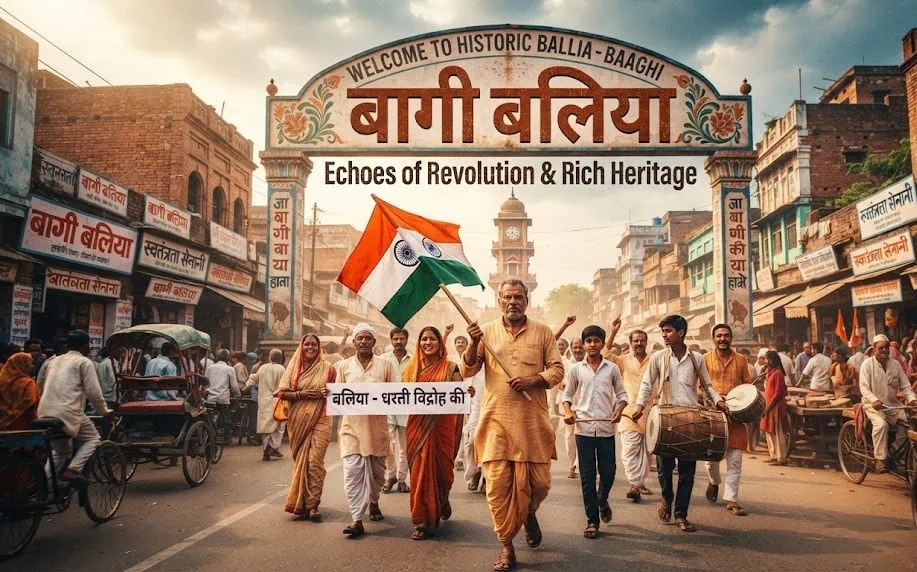
Baaghi Ballia is more than a name. It represents courage, patriotism, cultural pride and the strong spirit of the people of Ballia. Located in the eastern part of Uttar Pradesh, near the border of Bihar, Ballia is a district known for its revolutionary history, fertile agricultural land, Bhojpuri culture, religious traditions and vibrant rural life.
Often called Revolutionary Ballia, the district holds a special place in India’s freedom struggle. During the Quit India Movement of 1942, local freedom fighters challenged British authority and established a short-lived independent administration under the leadership of Chittu Pandey. This remarkable chapter in history helped give Ballia its enduring identity as Baaghi Ballia.
But Ballia is not defined by history alone. The district is home to important rivers, wetlands, temples, traditional fairs, educational institutions, markets, villages and a rich tradition of folk music and literature. Its people have contributed to India’s political, social and cultural development in many ways.
In this comprehensive guide, we explore Ballia’s history, geography, climate, administration, population, economy, agriculture, education, culture, festivals, tourist attractions, transportation, food and future development.
1. About Ballia District
Ballia is one of the easternmost districts of Uttar Pradesh, India. Its location near Bihar gives it a distinctive cultural identity influenced by both eastern Uttar Pradesh and the wider Bhojpuri-speaking region.
The district headquarters is Ballia city, which serves as an important centre for administration, trade, education, transportation and public services.
Ballia is widely recognised for its role in the Indian independence movement. Its historic resistance to British rule, particularly in August 1942, earned it the popular name Baaghi Ballia.
Ballia at a glance
- District: Ballia
- State: Uttar Pradesh, India
- District headquarters: Ballia city
- Popular identity: Baaghi Ballia
- Region: Eastern Uttar Pradesh, commonly called Purvanchal
- Languages: Hindi and Bhojpuri
- Population: 3,239,774 according to Census 2011
- Administrative divisions: Six tehsils and 17 development blocks
- Major rivers: Ganga and Ghaghara
- Major occupations: Agriculture, trade, services and small businesses
- Famous for: The 1942 freedom movement, Chittu Pandey, Bhojpuri culture, Dadri Mela and Surha Tal
The district administration’s website currently lists an area of 2,981 square kilometres. Historical census records and some older district pages contain different area figures, so the relevant official source and reporting year should be checked when using this number for formal research.
2. Why Is Ballia Called Baaghi Ballia?
The word baaghi means rebel or someone who refuses to accept unjust authority. Ballia earned this identity because of the extraordinary role played by its people during India’s struggle for independence.
In August 1942, when Mahatma Gandhi and the Indian National Congress launched the Quit India Movement, people across India began protesting against British rule. Ballia became one of the important centres of resistance in eastern Uttar Pradesh.
Students, local leaders, volunteers and ordinary residents participated in demonstrations and actions against colonial administration. Chittu Pandey emerged as one of the most prominent leaders of the movement in the district.
For a brief period in August 1942, British authority in Ballia was seriously disrupted, and a parallel popular administration was established. The administration was subsequently suppressed by British forces, but the event became an enduring symbol of local courage and resistance.
The story of Baaghi Ballia is remembered not simply as a political episode but as an expression of public determination. It represents the willingness of ordinary people to stand together for freedom.
Today, the name continues to inspire local pride. It connects present-day Ballia with the sacrifices of its freedom fighters and reminds younger generations of the importance of independence, justice and civic responsibility.
3. History of Ballia: From Ancient Settlements to Modern India
Ballia has a long and layered history. Its past includes ancient settlements, religious traditions, regional kingdoms, medieval political changes, colonial rule and participation in the national freedom movement.
3.1 Ancient history and early settlements
The area that forms present-day Ballia has been associated with the ancient region of Kosala and other political and cultural centres of the middle Gangetic plains.
The district administration’s historical account describes several ancient archaeological sites, including Mira Dih and Khaira Dih. Excavations at sites across the region have revealed archaeological material associated with early settled communities.
Findings of black-and-red ware pottery and other remains indicate that parts of the wider region supported settled life in ancient times. Such discoveries are important because they help researchers understand how communities lived, traded, worshipped and organised themselves in the Gangetic plains.
Ballia’s ancient history also includes religious and mythological traditions. Some local places are associated with sages and figures from Hindu tradition. These accounts form part of the region’s cultural heritage, although traditional beliefs should be distinguished from independently established archaeological evidence.
3.2 Ballia during ancient kingdoms
Over different periods, the region came under the influence of regional powers associated with Kosala, the Mallas, the Mauryan and post-Mauryan political landscape, the Kushanas and the Guptas.
The precise boundaries of ancient kingdoms did not correspond to modern district borders. Therefore, references to these empires indicate the wider historical setting rather than a continuous, clearly documented political history of present-day Ballia.
Archaeological discoveries, ancient settlements and regional historical records collectively demonstrate the area’s importance within the broader history of eastern Uttar Pradesh.
3.3 Medieval period
During the medieval period, political authority in eastern Uttar Pradesh changed several times. The region was influenced by neighbouring kingdoms and administrations associated with Jaunpur and other centres of power.
Rivers, agricultural settlements, local landholding communities and connections with neighbouring regions shaped everyday life. As in many parts of the Gangetic plains, the political history of the area was complex, and the degree of direct control over individual settlements varied over time.
The area’s position between eastern Uttar Pradesh and Bihar also contributed to cultural exchange, movement of people and commercial connections.
3.4 Ballia under British rule
British colonial administration brought new systems of revenue collection, policing, transport and government. However, colonial policies and political restrictions also contributed to growing dissatisfaction.
The people of Ballia participated in the wider national movement through political meetings, demonstrations, boycotts and support for nationalist activities.
The Non-Cooperation Movement of 1920–1922 attracted support in the district. Volunteers promoted khadi, encouraged the boycott of foreign goods and took part in demonstrations. Local participation in the freedom movement continued through subsequent phases of nationalist resistance.
These earlier activities helped create an environment in which the Quit India Movement of 1942 could develop into a major uprising.
4. The 1942 Revolution: The Most Defining Chapter in Ballia’s History
The Quit India Movement is central to understanding why Ballia is known as Baaghi Ballia.
On 8 August 1942, the Indian National Congress adopted the Quit India resolution in Bombay, calling for an end to British rule. News of the arrests of national leaders soon reached different parts of the country, including Ballia.
4.1 People rise against British authority
In Ballia, students and local residents organised demonstrations, raised patriotic slogans and protested against colonial institutions. The movement escalated as tensions increased and the authorities attempted to suppress public gatherings.
According to the district’s historical account, demonstrations and confrontations occurred during August 1942. Railway facilities, government buildings and other colonial administrative targets were affected during the unrest.
These events were part of a broader uprising in which people sought to weaken British control and demand independence.
4.2 The leadership of Chittu Pandey
Chittu Pandey, also written as Chittu or Chittu Pandey in English-language accounts, became the most prominent face of the Ballia uprising.
He is popularly remembered as Sher-e-Ballia, or the Lion of Ballia, because of his leadership during the freedom movement.
During the uprising, local leaders and freedom fighters challenged the district administration. A parallel popular government was established for a short period, with Chittu Pandey recognised as its leader.
Local accounts and historical sources differ in some details of the events and the exact sequence of the transfer of authority. Nevertheless, the establishment of a short-lived independent administration in August 1942 is a defining feature of Ballia’s freedom struggle.
4.3 The short-lived independent administration
For a brief period, the colonial administration lost effective control over significant parts of the district. Local volunteers and leaders attempted to maintain order and organise civil administration.
The event became one of the most remarkable examples of local resistance during the Quit India Movement. Ballia demonstrated that the demand for independence was not limited to major cities or national political leaders; it also had deep roots among ordinary people in smaller towns and villages.
British forces subsequently returned and suppressed the uprising. Participants faced arrests, punishment and repression.
Although the independent administration did not last, its symbolic importance remained powerful. Ballia’s experience became part of the larger national story of resistance to colonial rule.
4.4 Why the 1942 uprising matters today
The uprising reminds us that India’s independence struggle involved people from every part of the country. Ballia’s contribution is particularly memorable because local people briefly displaced colonial authority and attempted to govern themselves.
For the residents of the district, the episode is a source of identity and pride. For students and researchers, it offers an important example of popular mobilisation, local leadership and the challenges faced by colonial governments during the final decades of British rule.
Baaghi Ballia stands as a reminder that the struggle for freedom was built through collective courage, sacrifice and determination.
5. Geography of Ballia
Ballia lies in the eastern part of Uttar Pradesh, within the fertile Gangetic plains. Its geographical position near Bihar and its river systems have strongly influenced its agriculture, settlements, transportation and culture.
5.1 Location and boundaries
Ballia is surrounded by neighbouring districts and the state of Bihar. Mau lies to the west, Deoria to the north, while Ghazipur and the Bihar border are important parts of its wider geographical setting.
The exact river boundary and administrative boundary vary by location. The Ganga and Ghaghara rivers are particularly significant because they shape the landscape and separate parts of the district from neighbouring areas.
5.2 The Ganga River
The Ganga is one of the most important rivers in India and plays a major role in the geographical and cultural life of Ballia.
The river influences local agriculture, settlement patterns, religious practices and seasonal activities. Its floodplains contain fertile alluvial soils that support farming, although flooding and erosion can also damage fields, homes and infrastructure.
Riverbanks and ghats are important places for religious observances and community gatherings. The Ganga also connects Ballia with a much wider network of settlements, markets and pilgrimage destinations.
5.3 The Ghaghara River
The Ghaghara, also known as the Sarayu in some regional and religious contexts, is another major river associated with Ballia.
Its flow and seasonal changes affect nearby settlements, agricultural land and low-lying areas. During the monsoon, changes in river levels can create flood risks, while erosion may alter riverbanks and threaten farmland.
The Ganga and Ghaghara are not only physical features of the district; they are also deeply connected with local identity, traditions and everyday life.
5.4 Plains, soil and wetlands
Much of Ballia consists of relatively flat alluvial plains formed by river deposits over long periods.
These plains are generally suitable for agriculture. Soil characteristics vary from place to place, particularly near river channels, older floodplains and low-lying wetlands.
Ballia also contains lakes and wetlands that support birds, aquatic life and local ecological systems. Surha Tal is among the district’s best-known natural features.
5.5 Climate of Ballia
Ballia experiences a typical north Indian climate with hot summers, a monsoon season and cool winters.
- Summer: Temperatures can become very high, especially during May and June.
- Monsoon: Rainfall generally arrives during the summer monsoon, helping crops grow but sometimes causing waterlogging and flooding.
- Winter: The weather is usually cooler and often more comfortable for outdoor activities and sightseeing.
- Spring and autumn: These transitional seasons can offer pleasant conditions, depending on rainfall and temperature.
Weather conditions vary from year to year. Anyone planning travel should check the forecast, particularly during the monsoon and periods of extreme heat.
6. Population and Demographics of Ballia
Ballia has a substantial rural population and a strong connection between village life and the district’s urban centres.
According to Census 2011, the district had a population of 3,239,774 people, including 1,672,902 males and 1,566,872 females. These are historical census figures, not a current population count.
The 2011 census-based district profile also recorded a predominantly rural population, reflecting the importance of agriculture, village communities and local markets.
6.1 Rural and urban life
Rural Ballia is characterised by agricultural activity, village institutions, family networks, local festivals and community traditions.
Ballia city and other urban settlements provide administrative services, schools, colleges, healthcare facilities, markets, transport connections and employment opportunities.
The relationship between villages and towns is important to the local economy. Farmers sell agricultural produce through market networks, students travel for education, and residents depend on urban centres for many professional and public services.
6.2 Language and communication
Hindi and Bhojpuri are the main languages associated with Ballia. Bhojpuri is particularly important in everyday conversations, folk songs, oral storytelling and cultural celebrations.
Hindi is widely used in education, administration, formal communication and media. Many residents also use regional expressions that reflect the area’s shared cultural links with neighbouring districts of Uttar Pradesh and Bihar.
6.3 Social and cultural diversity
Ballia’s population includes people from different communities, occupations and social backgrounds. Hindu and Muslim traditions, along with other local cultural influences, contribute to the district’s social life.
Festivals, markets, educational institutions and community gatherings create opportunities for people to interact across generations and backgrounds.
7. Administrative Structure of Ballia District
Ballia is administered through district-level government offices, tehsils, development blocks, village institutions and urban local bodies.
The district administration is responsible for public services, revenue administration, law and order coordination, development programmes and the implementation of government schemes.
7.1 Six tehsils of Ballia
The district administration lists six tehsils:
- Ballia Sadar
- Belthara Road
- Bansdih
- Bairia
- Rasra
- Sikandarpur
Tehsils play an important role in land records, revenue administration, certificates and other public services.
7.2 Development blocks
Ballia has 17 development blocks listed by the district administration:
- Bansdih
- Belhari
- Beruarbari
- Chilkahar
- Dubhar
- Garwar
- Hanumanganj
- Maniyar
- Murli Chhapra
- Nagra
- Nawanagar
- Pandah
- Rasra
- Revati
- Siar
- Sohaon
- Bairia
Development blocks help coordinate rural development work, local infrastructure, welfare programmes and village-level planning.
7.3 Villages and local government
Village communities form the foundation of rural Ballia. Gram panchayats participate in local governance, public works, sanitation, water-related activities and rural development programmes.
Urban local bodies, meanwhile, manage services such as roads, drainage, street lighting and waste management within their respective jurisdictions.
Administrative counts may change over time due to government notifications and boundary revisions. For official work, the latest district administration records should always take precedence over older directories.
8. Agriculture and the Rural Economy
Agriculture is a major part of Ballia’s economic and social life. Fertile alluvial soils, river systems and a large rural population have helped make farming central to the district’s development.
8.1 Major crops
Depending on soil, irrigation and local conditions, farmers grow crops such as:
- Wheat
- Paddy or rice
- Pulses
- Mustard and other oilseeds
- Maize
- Seasonal vegetables
- Fodder crops
Crop patterns vary between villages and agricultural seasons. Many farming households combine crop cultivation with livestock rearing and other sources of income.
8.2 Irrigation and farming practices
Farmers use a combination of rainfall, groundwater and irrigation infrastructure to support cultivation.
Access to irrigation, agricultural inputs, quality seeds, storage, market prices and transport can influence farm productivity and income.
Modern farming methods, soil testing, improved water management and access to reliable agricultural information can help farmers make better decisions.
8.3 Challenges faced by farmers
Agriculture in Ballia faces several challenges common to riverine districts of the Gangetic plains.
These include seasonal flooding, riverbank erosion, waterlogging in some areas, extreme heat, changes in rainfall, rising cultivation costs and fluctuations in crop prices.
Improved flood management, crop insurance awareness, better storage facilities, market access and sustainable irrigation practices can strengthen the rural economy.
8.4 Livestock and local markets
Livestock rearing is part of rural livelihoods. Cattle, buffaloes, goats and poultry can supplement household income and support agricultural activity.
Traditional markets and fairs, including the well-known Dadri Mela, provide important spaces for trade, social interaction and cultural exchange.
9. Business, Trade and Employment in Ballia
Ballia’s economy includes agriculture, retail trade, transport, education, healthcare, construction, government services and small enterprises.
The district headquarters acts as an important commercial centre. Other towns and market areas support surrounding villages by providing shops, agricultural services, banking, professional services and everyday goods.
9.1 Small businesses and local entrepreneurship
Small businesses play an important role in employment and local economic activity. Retail stores, food businesses, repair services, coaching centres, transport operators and agricultural traders serve the needs of residents.
Digital services and online businesses also offer opportunities for people who want to work with customers outside the district.
9.2 Opportunities for young people
Young people in Ballia increasingly have opportunities in technology, digital marketing, online education, content creation, remote work and entrepreneurship.
Access to digital skills, professional training, reliable internet and career guidance can help local residents explore employment beyond traditional sectors.
Local news platforms and district-focused websites can also help promote businesses, events, tourism and public information.
9.3 The importance of local markets
Markets connect rural producers with consumers and provide essential goods and services. They are also social spaces where people meet, exchange information and participate in community life.
Strengthening market infrastructure, digital payments, logistics and small-business support can contribute to the district’s long-term economic development.
10. Education in Ballia
Education is important to Ballia’s social development and future employment opportunities.
The district has schools, colleges, professional institutions, coaching centres and other educational facilities. Students also travel to larger educational centres in eastern Uttar Pradesh and neighbouring states for specialised courses and higher education.
10.1 School education
Government and private schools serve students across urban and rural areas.
Important priorities include improving learning outcomes, supporting teachers, providing access to digital learning resources and ensuring that students can continue their education regardless of their financial circumstances.
10.2 Higher education
Colleges and higher-education institutions provide opportunities in arts, science, commerce and other disciplines. Students seeking professional qualifications may also consider institutions in nearby regional centres.
Families should check official admission notifications, eligibility criteria, fee structures, accreditation and course availability before choosing an institution.
10.3 Digital education and skills
Computer skills, English communication, programming, accounting, design and digital marketing can help students prepare for changing employment opportunities.
Online courses and remote learning can complement traditional education, especially when students have limited access to specialised training locally.
11. Culture and Traditions of Ballia
Ballia’s culture is closely connected with the Bhojpuri-speaking region. Folk music, oral storytelling, family traditions, religious observances, seasonal celebrations and community gatherings form an important part of local life.
11.1 Bhojpuri language and identity
Bhojpuri is more than a means of communication; it is a cultural expression that carries local humour, emotions, proverbs, folk wisdom and collective memory.
It is heard in homes, marketplaces, weddings, festivals, folk performances and informal conversations.
The Bhojpuri language also connects Ballia with neighbouring districts and communities across eastern Uttar Pradesh and Bihar.
11.2 Folk music
Traditional Bhojpuri music includes songs associated with weddings, harvests, religious occasions, seasonal changes and family life.
Popular forms include sohar songs celebrating childbirth, vivah geet for weddings, kajri associated with the monsoon, and other regional folk traditions.
These songs often preserve memories, describe everyday struggles and celebrate relationships, festivals and rural life.
11.3 Folk performance and storytelling
Ramlila, Raslila, Nautanki, Birha and other regional performance traditions have contributed to the cultural life of the wider Bhojpuri region.
The popularity of individual forms varies by locality and generation, but folk performance remains an important part of the region’s artistic heritage.
11.4 Family and community traditions
Weddings, religious ceremonies, seasonal festivals and community gatherings often bring together extended families and neighbours.
Traditional food, music, hospitality and regional language help maintain a strong sense of belonging.
At the same time, Ballia’s culture continues to evolve as residents travel, pursue education, use digital media and interact with people from other regions.
12. Festivals Celebrated in Ballia
Festivals in Ballia combine religious devotion, cultural expression, family gatherings and community participation.
12.1 Dadri Mela
Dadri Mela is one of Ballia’s best-known traditional fairs. It is associated with the area near Ballia city and is held around Kartik Purnima, generally in October or November.
The fair is traditionally connected with Dardar Muni, described in local accounts as a disciple of Maharishi Bhrigu. It has historically included cattle trading, markets, religious activities and cultural programmes.
The fair brings together traders, farmers, families, visitors and local businesses. It is an important expression of Ballia’s rural economy and cultural identity.
Visitors should check the latest official dates, transport arrangements and local advisories before travelling.
12.2 Chhath Puja
Chhath Puja is an important festival across the Bhojpuri-speaking region, including Ballia.
Devotees offer prayers to the Sun and observe rituals at riverbanks, ponds and other water bodies. The festival is associated with discipline, devotion, family well-being and gratitude for nature.
During Chhath, riverbanks and local water bodies become centres of community activity. Families prepare traditional offerings and participate in rituals that are passed from one generation to another.
12.3 Diwali and Holi
Diwali is celebrated with lamps, decorations, prayers, sweets and family gatherings. Holi brings colours, music and social celebrations.
Both festivals are widely observed, although customs differ between families and localities.
12.4 Eid and other religious festivals
Eid and other religious occasions are also part of Ballia’s diverse social calendar. People celebrate according to their own traditions, and local markets often become busier during major festivals.
Makar Sankranti, Navratri, Durga Puja, Janmashtami and other occasions are observed in different parts of the district.
12.5 Local fairs and seasonal celebrations
Apart from major religious festivals, local fairs, village gatherings and seasonal celebrations provide opportunities for trade, entertainment and cultural exchange.
These events help preserve traditional practices while supporting local vendors, artisans and small businesses.
13. Famous Tourist Places in Ballia
Ballia offers a mix of historical interest, religious sites, wetlands and traditional fairs. Visitors interested in culture, nature and local history can explore several places across the district.
13.1 Surha Tal
Surha Tal is one of Ballia’s best-known natural attractions. It is a lake and wetland ecosystem associated with the district’s birdlife and natural landscape.
During suitable seasons, the wetland attracts resident and migratory birds. It is particularly interesting for nature lovers, photographers and visitors who enjoy quiet outdoor spaces.
The wetland is also ecologically important because lakes and marshes provide habitats for birds and other wildlife.
Visitors should avoid disturbing birds, littering or damaging the natural environment. Access conditions and conservation rules should be checked before a visit.
13.2 Bhrigu Ashram and Bhrigu Temple
Bhrigu Ashram and the associated temple are important religious places in Ballia city.
The site is linked with Maharishi Bhrigu in local religious tradition and holds significance for many residents. People visit to offer prayers and participate in religious observances.
For travellers interested in the spiritual heritage of the district, the temple provides a way to understand local beliefs and traditions.
13.3 Dadri Mela grounds
The Dadri Mela grounds are particularly lively during the annual fair. Visitors can experience local trading traditions, temporary markets, food stalls and cultural activities.
The fair is a good example of how a traditional event can combine religion, commerce, recreation and community identity.
13.4 Local temples and ghats
Ballia and its surrounding villages contain numerous temples, shrines and riverfront sites.
Some are important for daily worship, while others become especially active during festivals and religious gatherings.
Because opening hours and facilities vary, visitors should confirm local information before planning a detailed itinerary.
13.5 Historical places and village heritage
Ballia’s historical landscape also includes archaeological sites and villages associated with local history.
Mira Dih and Khaira Dih are mentioned in the district’s historical account in connection with ancient remains. Such places are of interest to those studying archaeology and regional history, although public access and visitor facilities may be limited.
Visitors should respect private property and archaeological protections and should not remove objects or disturb historical remains.
14. Food and Cuisine of Ballia
Ballia’s food reflects the wider Bhojpuri and eastern Uttar Pradesh culinary tradition. Home-cooked meals, seasonal produce, wheat-based breads, rice, pulses and vegetables are central to everyday eating.
14.1 Everyday food
Common meals may include roti, rice, dal, seasonal vegetables, curd, pickles and chutneys.
The precise menu varies according to household preferences, agricultural seasons and family traditions.
14.2 Traditional dishes and snacks
Popular foods across the wider regional cuisine include:
- Litti-chokha: Roasted wheat-flour balls filled with seasoned gram flour, served with mashed vegetables.
- Sattu paratha: Flatbread prepared with a roasted gram-flour filling.
- Kachori and puri-sabzi: Common market and breakfast foods.
- Jalebi: A popular sweet often enjoyed at fairs and celebrations.
- Seasonal sweets: Local shops sell a variety of sweets depending on the season and occasion.
These foods are common across parts of eastern Uttar Pradesh and Bihar, so they should be understood as regional favourites rather than dishes exclusive to Ballia.
14.3 Food during festivals
Special foods are prepared during weddings, religious festivals and family occasions.
During Chhath Puja, traditional offerings such as thekua are widely associated with the festival in the Bhojpuri region.
Food is an important part of hospitality and community life, and fairs offer visitors an opportunity to sample local snacks and sweets.
15. Transportation: How to Reach Ballia
Ballia is connected to nearby towns and larger cities by road and rail. Its transport links support travel for education, employment, trade, healthcare and tourism.
15.1 By train
Ballia railway station is an important rail connection for the district. Other useful stations in the wider district include Belthara Road, Rasra and Suraimanpur.
Train services and routes change, so passengers should check current schedules, seat availability and station information through official railway channels before travelling.
15.2 By road
Ballia is connected by roads to regional centres including Varanasi, Gorakhpur, Ghazipur and Patna through different routes.
Travellers can use buses, private vehicles and local transport depending on their destination. Road conditions and journey times vary with traffic, weather and ongoing construction.
15.3 By air
Air travellers generally consider airports in Varanasi or Patna, depending on their route and flight availability.
The onward journey requires road or rail transport. Actual travel times depend on the airport, destination within Ballia, traffic and available connections.
15.4 Local transport
Auto-rickshaws, e-rickshaws, taxis, buses and other local transport options may be available depending on the town or village.
Visitors travelling to rural attractions should arrange return transport in advance, especially when visiting areas with limited evening services.
16. Healthcare and Public Services
Healthcare access is important for a district with a large rural population. Residents may use government hospitals, community health centres, primary health centres, private clinics, pharmacies and other medical services depending on their location and needs.
Availability of specialists and emergency services varies between urban and rural areas.
For emergencies, residents should use the appropriate official emergency service. For routine treatment, it is useful to check a facility’s services, opening hours and specialist availability before travelling.
Public services in Ballia also include land and revenue offices, police services, education departments, welfare schemes, identity documentation, local government and digital service portals.
Residents should prefer official government websites for applications, certificates, grievance submissions and public notices.
17. Famous Personalities Associated with Ballia
Ballia is associated with several personalities remembered for their contributions to India’s freedom struggle, politics, literature and public life.
17.1 Chittu Pandey
Chittu Pandey is the most prominent figure associated with the 1942 uprising in Ballia. He is remembered for his leadership during the short-lived popular administration established during the Quit India Movement.
His name remains closely connected with the district’s identity as Baaghi Ballia.
17.2 Mangal Pandey
Mangal Pandey, the soldier associated with the events leading to the Revolt of 1857, is widely linked with Ballia in popular regional memory. His resistance to British authority made him an enduring figure in the history of India’s anti-colonial struggle.
Accounts of historical personalities should be checked against reliable biographies and official historical records when precise birthplace or biographical details are required.
17.3 Chandra Shekhar
Chandra Shekhar, who served as Prime Minister of India in 1990–1991, is another major political figure associated with Ballia.
His political career and role in national public life have made him an important name in discussions of the district’s modern political history.
17.4 Janeshwar Mishra
Janeshwar Mishra, popularly known as Chhote Lohia, was a prominent socialist politician associated with Uttar Pradesh politics.
He is remembered for his political activism and contribution to socialist public life.
17.5 Writers and scholars
Ballia and its wider region have connections with writers, scholars and literary figures, including Hazari Prasad Dwivedi and Amarkant, as noted in district cultural materials.
Such associations reflect the importance of education, literature and intellectual life in the region.
18. Ballia in Literature, Poetry and Media
Ballia’s language, political history and rural culture provide rich material for writers, poets, journalists and researchers.
Bhojpuri folk songs preserve memories of migration, family relationships, seasonal changes, social struggles and everyday experiences. Hindi literature and regional storytelling also provide ways to explore the district’s changing identity.
Local journalism is important for documenting public events, government decisions, education, agriculture, employment, transport, sports, cultural activities and community concerns.
Digital platforms can help preserve local history and make district-level information accessible to people living in Ballia as well as those who have moved elsewhere.
A well-maintained district website can also serve as a resource for students, researchers, visitors, local businesses and members of the Ballia community living outside Uttar Pradesh.
19. Challenges Facing Ballia
Like many districts in the Gangetic plains, Ballia faces challenges related to infrastructure, employment, agriculture, public services and environmental change.
19.1 Flooding and riverbank erosion
The Ganga and Ghaghara are vital to the district, but changing river levels can create serious risks for vulnerable settlements.
Flooding, erosion and waterlogging can affect homes, roads, farmland and livelihoods.
Flood preparedness, reliable early warnings, resilient infrastructure and appropriate land-use planning are important for reducing these risks.
19.2 Employment and migration
People may move to larger cities or other states in search of employment, higher wages and specialised education.
Expanding local enterprises, improving skills and strengthening digital employment opportunities can help create more choices for young people.
19.3 Education and healthcare access
Differences in transport, facilities, staffing and affordability can affect access to education and healthcare, especially in remote rural areas.
Continued investment in public services, digital access and professional training can support more inclusive development.
19.4 Environmental protection
Wetlands, rivers, groundwater and agricultural soils are valuable natural resources. Pollution, unplanned development and careless disposal of waste can harm these systems.
Protecting Surha Tal and other wetlands, improving waste management and promoting responsible water use are important parts of sustainable development.
20. The Future of Ballia: Opportunities for Growth
Ballia has opportunities to build on its cultural heritage, agricultural strengths and strategic location near Bihar.
20.1 Digital development
Better digital infrastructure can help residents access online education, government services, banking, healthcare information and employment opportunities.
Local entrepreneurs can use e-commerce, digital marketing and online services to reach customers beyond their immediate markets.
20.2 Agricultural modernisation
Better storage, food processing, irrigation management, agricultural information and links between farmers and markets can support rural incomes.
Training and access to reliable agricultural advice can help farmers adopt suitable technologies and practices.
20.3 Heritage and nature tourism
Ballia’s revolutionary history, religious sites, traditional fairs and wetlands provide opportunities for responsible tourism.
Improved visitor information, cleanliness, transport guidance, local guides and heritage interpretation could help visitors understand the district more fully.
Tourism development should protect the environment and respect the traditions of local communities.
20.4 Education and entrepreneurship
Career guidance, technical training, entrepreneurship support and digital skills can help young people prepare for new forms of work.
Local businesses, educational institutions and community organisations can play a role in developing these opportunities.
21. Why Ballia Deserves More Recognition
Ballia deserves recognition not only because of its role in the freedom struggle but also because of the everyday life and contributions of its people.
Its villages sustain agricultural traditions. Its language preserves a distinctive cultural identity. Its markets support local livelihoods. Its festivals bring communities together. Its students and workers contribute to society across India and abroad.
The story of Baaghi Ballia also reminds us that history is not made only in capitals or by famous national leaders. It is shaped by people in smaller towns and villages who take risks, organise collectively and stand up for what they believe is right.
Understanding Ballia means understanding both its revolutionary past and its continuing efforts to build a better future.
Conclusion: Baaghi Ballia — A Land of Courage, Culture and Pride
Ballia is a district where history, geography and culture come together to create a distinctive regional identity. The Ganga and Ghaghara shape its landscape, fertile plains support agriculture, and Bhojpuri traditions connect its people with a wider cultural region.
Its most enduring legacy remains the freedom struggle of 1942, when local people challenged British authority and briefly established a popular administration under Chittu Pandey. That event gave lasting meaning to the name Baaghi Ballia.
At the same time, Ballia is a living district with schools, businesses, villages, markets, religious centres, wetlands and young people looking toward new opportunities.
Preserving its history, supporting local communities, protecting its natural environment and improving access to education, healthcare and employment are essential for its future.
For anyone interested in India’s freedom movement, eastern Uttar Pradesh, Bhojpuri culture or the life of the Gangetic plains, Ballia offers a story worth exploring.
Baaghi Ballia is not just a place on the map. It is a symbol of courage, identity and the enduring spirit of its people.
Frequently Asked Questions About Ballia
1. Why is Ballia called Baaghi Ballia?
Ballia is called Baaghi Ballia because of its prominent role in the Quit India Movement of 1942. Local freedom fighters challenged British authority and established a short-lived popular administration under Chittu Pandey.
2. Where is Ballia located?
Ballia is located in the eastern part of Uttar Pradesh, India, near the border of Bihar. It lies within the fertile Gangetic plains and is associated with the Ganga and Ghaghara river systems.
3. Who was Chittu Pandey?
Chittu Pandey was a freedom fighter and a leading figure in Ballia’s 1942 uprising. He is remembered for his role in the brief popular administration established during the Quit India Movement.
4. What is the population of Ballia district?
According to Census 2011, Ballia district had a population of 3,239,774. This is the historical census figure, not a current population estimate.
5. Which rivers are important in Ballia?
The Ganga and Ghaghara are the two major rivers associated with Ballia. They influence agriculture, settlements, flood patterns and local religious traditions.
6. What languages are spoken in Ballia?
Hindi and Bhojpuri are widely used in Ballia. Bhojpuri is especially important in everyday conversation, folk music and local cultural traditions.
7. How many tehsils are there in Ballia?
Ballia district has six tehsils: Ballia Sadar, Belthara Road, Bansdih, Bairia, Rasra and Sikandarpur, according to the district administration.
8. What are the famous tourist attractions in Ballia?
Important places include Surha Tal, Bhrigu Ashram and Temple, local temples and ghats, and the Dadri Mela grounds during the annual fair. Visitors interested in history can also explore documented heritage sites in the district.
9. What is Dadri Mela famous for?
Dadri Mela is known for its traditional cattle trading, markets, religious associations and cultural activities. It is held around Kartik Purnima, usually in October or November.
10. What is the main occupation in Ballia?
Agriculture is a major occupation, supported by trade, retail, transport, services, education, small businesses and other forms of employment.
11. How can you reach Ballia?
Ballia can be reached by train and road. Travellers may also use airports in Varanasi or Patna and continue by road or rail. Current routes and schedules should be checked before travel.
12. What is the best time to visit Ballia?
October to February is generally a comfortable period for sightseeing because the weather is cooler than during the peak summer months. Visitors planning around festivals should verify the dates for the relevant year.
13. What is Surha Tal known for?
Surha Tal is known for its lake and wetland environment and for attracting resident and migratory birds. It is a notable natural attraction for nature lovers and birdwatchers.
14. Which famous personalities are associated with Ballia?
Chittu Pandey, Mangal Pandey, Chandra Shekhar and Janeshwar Mishra are among the prominent names associated with Ballia in historical and regional accounts.
15. Why should people learn about Ballia’s history?
Learning about Ballia helps people understand the local participation in India’s independence movement, the importance of regional culture and the contributions of communities outside the major political centres.
About this guide: This article is intended as an introductory district guide. Population and administrative figures should be checked against the latest official records when they are used for academic, legal or government purposes.
Reliable sources to reference
These official and primary-source references can support the article’s historical and factual claims.
- District Ballia official website — administrative overview and district profile.
- Official history of Ballia — ancient history and the 1942 freedom movement.
- About Ballia district — geographical setting, regional identity and background.
- Ballia demography — Census 2011 population and demographic tables.
- Ballia tehsils — administrative divisions.
- Places of interest in Ballia — Surha Tal and local attractions.
- Official Dadri Mela information — the annual fair and visitor information.
- Ministry of Culture: Ballia’s freedom struggle — historical account of the 1942 uprising.